English
  Arabic

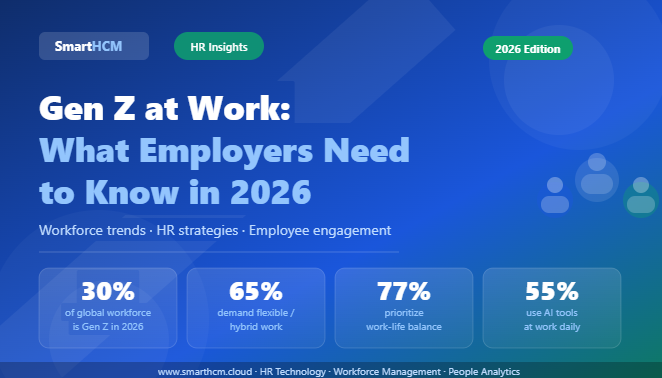
Gen Z at Work!
Gen Z at Work: What Employers Need to Know in 2025 | SmartHCM SmartHCM Home › Blog › Gen Z at Work HR Insights Workforce Trends 2025 Gen Z at Work: What Employers Need to Know in 2025 The next generation is already in your office — and they’re changing everything from hiring to culture to how feedback gets delivered. 📅 June 3, 2025 🕐 8 min read ✍️ SmartHCM Editorial Team 30% of global workforce is Gen Z in 2025 65% of Gen Z demand flexible / hybrid work 77% prioritize work-life balance in job offers 55% already use AI tools at work daily 📋 Table of Contents Who Is Gen Z? A Quick Overview Gen Z Workplace Expectations Common Challenges Employers Face HR Strategies to Attract & Retain Gen Z Gen Z and Technology / AI at Work Mental Health & Well-Being How SmartHCM Helps You Manage Gen Z Frequently Asked Questions The modern workplace is in the middle of a generational handover. Generation Z — born between 1997 and 2012 — is no longer just entering the workforce. They are reshaping it. By 2025, Gen Z makes up nearly 30% of the global workforce, and that number is climbing fast. For HR leaders, business owners, and managers, understanding what Gen Z wants — and what they won’t tolerate — is no longer optional. It’s a competitive necessity. In this guide, we break down everything employers need to know about Gen Z at work: their expectations, work styles, strengths, challenges, and the HR strategies that actually work. 1. Who Is Gen Z? A Quick Overview Generation Z — also called Zoomers or Post-Millennials — grew up as true digital natives. They were the first generation to have smartphones in their pockets during high school, social media during their formative years, and a global pandemic disrupting their early careers. These experiences fundamentally shaped how they view work, loyalty, money, and purpose. Key fact: In Q2 2024, for the first time in history, there were officially more Gen Z employees (18%) than Baby Boomers (15%) in the U.S. workforce — a symbolic milestone marking a true generational shift. Unlike Millennials who chased promotions and homeownership, Gen Z is more pragmatic. They watched their parents lose jobs in the 2008 recession, graduated during or after a pandemic, and entered a volatile job market. Financial security, mental well-being, and purposeful work are their non-negotiables. 2. What Are Gen Z’s Workplace Expectations? Understanding Gen Z workplace expectations is the first step to building a people strategy that works. Here’s what the data tells us: 🔹 Flexible & Hybrid Work Arrangements A striking 65% of Gen Z employees consider remote or hybrid work the most important factor when evaluating a job. Up to 80% prefer hybrid roles, valuing autonomy and the ability to balance personal obligations without sacrificing professional growth. Employers who demand 100% in-office presence are increasingly losing Gen Z candidates to more flexible competitors. 🔹 Purpose-Driven Work Gen Z doesn’t just want a paycheck. 70% want personal alignment with their employer’s values — including sustainability, ethical practices, and social responsibility. They choose employers whose mission aligns with their own. Purpose is a recruitment tool. 🔹 Diversity, Equity & Inclusion (DEI) 75–77% of Gen Z candidates say DEI is a critical factor when choosing where to work. A diverse and inclusive culture isn’t a “nice-to-have” for this generation — it’s a dealbreaker if absent. 🔹 Fast Career Progression Unlike previous generations, 70% of Gen Z recent graduates expect a promotion within the first 18 months of employment. They want clear career paths, regular feedback, and opportunities to grow fast. Flat organizations that offer no upward mobility lose Gen Z talent quickly. 🔹 Competitive Compensation Financial security is a major concern — 74% of Gen Z workers would leave a job because of a low salary. They know their market value and are not afraid to negotiate or walk away. Transparent pay practices build trust with this generation. 3. Common Challenges Employers Face with Gen Z While Gen Z brings immense value, employers also report specific friction points. Acknowledging these honestly is the first step to solving them. Short job tenure: Gen Z has low tolerance for stagnant roles. If growth stalls, they move on — often within a year. Communication style differences: Accustomed to instant digital communication, they may find email-heavy or meeting-heavy cultures frustrating and inefficient. Feedback frequency: Annual performance reviews feel outdated to them. They expect continuous, real-time feedback. Engagement dips: Work engagement among Gen Z dropped from 84% in 2023 to 81% in 2024 — a warning sign that companies must act on proactively. Mental health challenges: 71% of Gen Z employees report “unhealthy” work-health scores — a significantly higher rate than older generations. 4. HR Strategies to Attract & Retain Gen Z Talent Adapting your HR strategy for Gen Z doesn’t mean abandoning structure — it means building a more human, transparent, and flexible workplace. Here’s what works: ✅ Modernize Your Recruiting Process Gen Z applies via mobile, researches companies on Instagram and LinkedIn, and expects fast responses. Optimize your careers page for mobile, use video job descriptions, and streamline hiring to under 2 weeks where possible. Slow processes lose top Gen Z candidates. 💡 SmartHCM Tip SmartHCM’s applicant tracking system (ATS) automates screening, interview scheduling, and offer letters — cutting your time-to-hire significantly. ✅ Offer Flexible Work Policies Implement hybrid work models, flexible start times, and result-based performance metrics rather than hours-based ones. Document your flexibility policies clearly in job postings — it’s now a key differentiator. ✅ Build a Continuous Feedback Culture Replace annual reviews with monthly 1-on-1s and real-time performance check-ins. Gen Z thrives on immediate, constructive feedback. HR platforms that enable ongoing performance conversations — rather than one-a-year events — retain Gen Z employees far better. ✅ Invest in Learning & Development Offer clear career ladders, internal mobility, mentorship programs, and access to online learning platforms. Gen Z who see growth opportunities are 3x