 English
  Arabic

Contents
- 1 Reactive HR vs Strategic Workforce Planning: Why Hiring, Culture, and Leadership Must Be Planned
- 2 The Reactive HR Trap
- 3 What Strategic Workforce Planning Entails
- 4 The Strategic Advantage: Research and Analytics
- 5 Bridging Behavior and Technology
- 6 A Food for Thought for HR Leaders
- 7 Final Thought
- 8 References
Reactive HR vs Strategic Workforce Planning: Why Hiring, Culture, and Leadership Must Be Planned
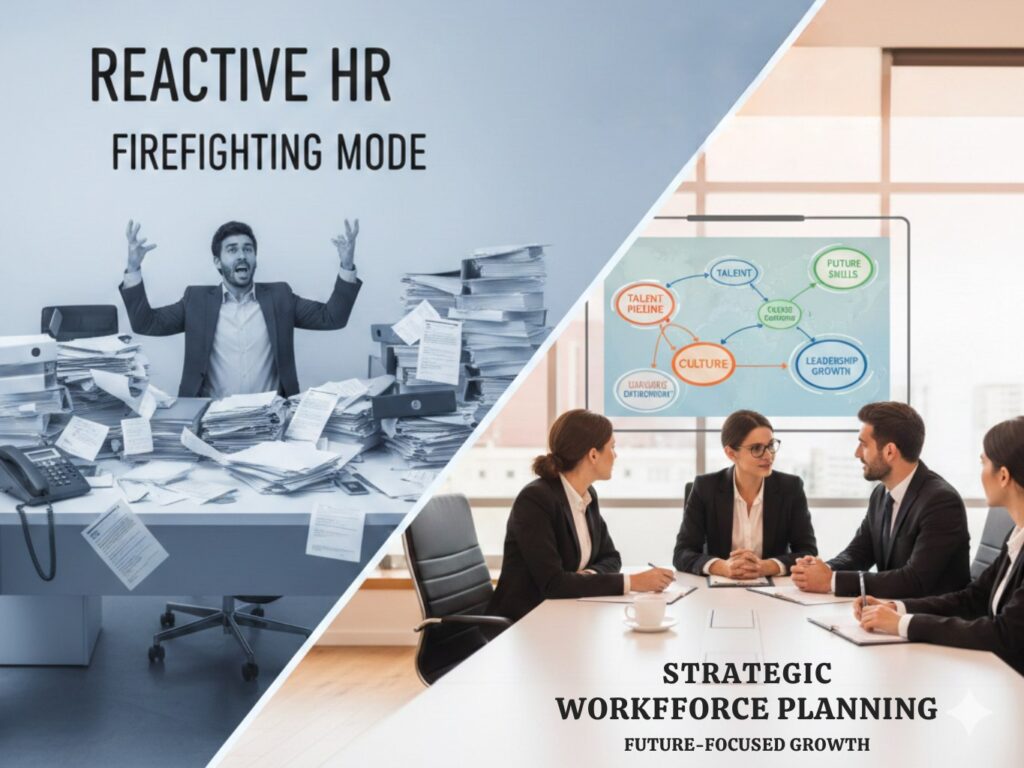
As organisations scale, the role of Human Resources evolves far beyond administering payroll or processing leave requests. Growth brings complexity — from diversified teams to layered leadership structures and shifting cultural norms. Yet too many HR departments remain trapped in reactive mode, responding to issues only after they surface. The contrasting paradigm — strategic workforce planning — positions HR as a pivotal driver of long-term organisational success.
At its core, reactive HR is operational: it solves immediate problems, fills open positions when a manager asks, and puts out fires as they flare. Strategic workforce planning, by contrast, is proactive and integrative. It anticipates future talent needs, aligns HR initiatives with business strategy, and builds organisational resilience. This difference is most visible not just in outcomes like time-to-hire or retention, but in how organisations navigate disruption, culture change, and leadership development.
The Reactive HR Trap
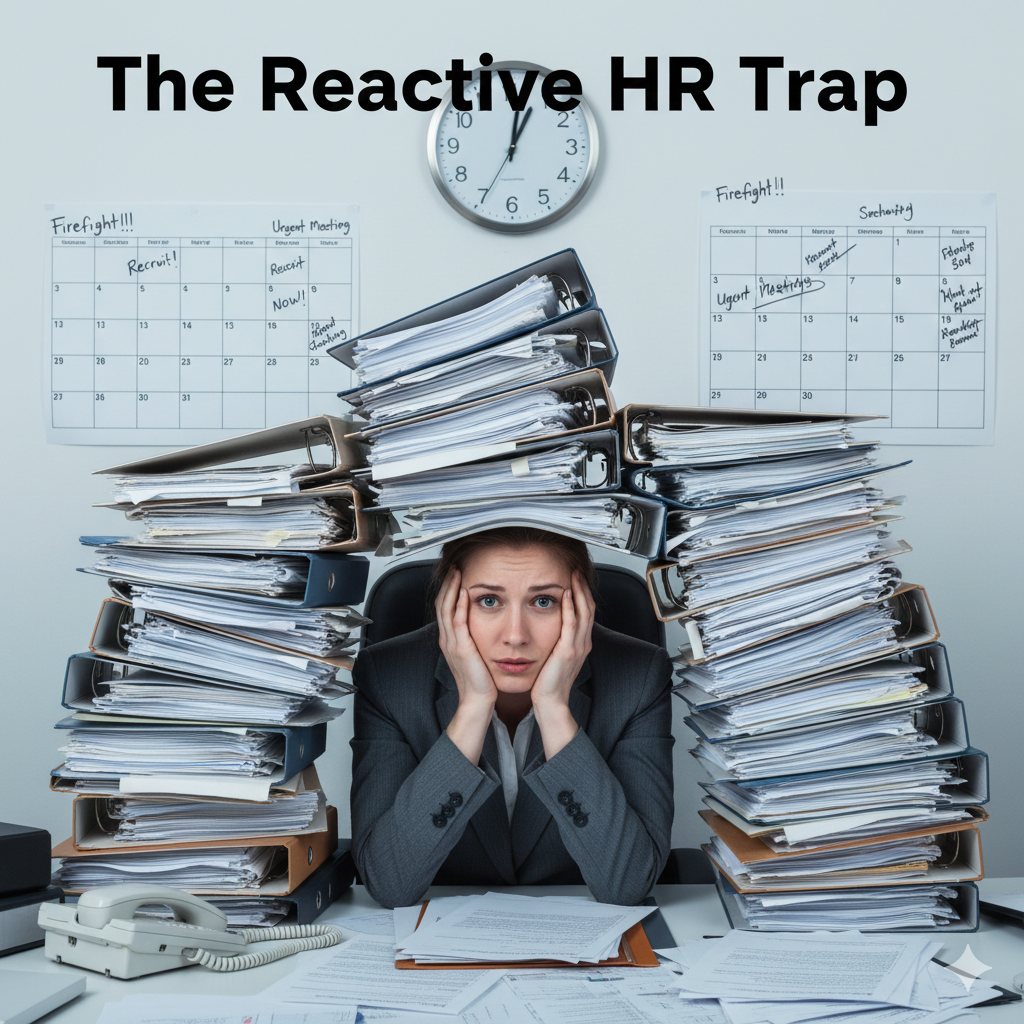
Reactive HR carries a familiar rhythm. A team loses a high-performer and the department scrambles to refill the vacancy. Skills gaps emerge, and training is offered on the fly. Leadership succession is discussed only when a critical role becomes unexpectedly vacant. While such responsiveness is understandable, especially in resource-constrained environments, it tends to produce short-term fixes rather than strategic outcomes.
One key limitation of reactive HR is its narrow focus on transactional metrics — such as hiring costs, vacancy fill time, or payroll accuracy — without connecting them to overarching business goals. Traditional HR teams often lack access to advanced analytics or workforce insights, relying instead on intuition and historic patterns. This produces decisions that address symptoms rather than root causes and results in unpredictable workforce performance.
Furthermore, when HR is reactive, culture and leadership are treated as by-products of operations rather than strategic pillars. Recruitment becomes a series of isolated events rather than a pipeline of future leaders. Training becomes sporadic rather than aligned with projected competency needs. In fast-changing business landscapes, this can leave organisations struggling to keep pace.
What Strategic Workforce Planning Entails
Strategic workforce planning flips the traditional HR model on its head. Rather than reacting, it forecasts talent needs; rather than filling roles, it builds talent pipelines; and rather than administering policy, it influences organisational direction. It requires HR professionals to engage with business leaders, understand competitive and market trends, and leverage data to shape decisions that support long-term success.
At a practical level, strategic workforce planning involves:
- Current State Assessment: Understanding existing workforce capabilities and identifying gaps that may hinder future goals.
- Future State Visioning: Defining what skills, roles, and leadership profiles the organisation will need to execute its strategic objectives.
- Gap Closure Strategies: Designing interventions — such as targeted recruitment, upskilling programmes, succession planning, and revised talent management policies — that bridge current capabilities with future requirements.
This is not HR by checklist. It is HR that intimately aligns with corporate strategy, driving both organisational performance and people outcomes. And the research shows that this alignment is not only desirable — it is essential.
The Strategic Advantage: Research and Analytics
Despite its clear value, maturity in strategic workforce planning remains limited. Deloitte research indicates that only a small percentage of organisations demonstrate advanced workforce planning capabilities integrated into business strategy. Many companies still rely on short-term hiring forecasts rather than long-range workforce modelling.
Yet where strategic workforce planning is embedded, measurable benefits emerge:
- Cost Efficiency: Anticipating talent needs reduces unnecessary churn and over-hiring, lowering recruitment and onboarding expenses.
- Improved Retention: Career pathway visibility and internal mobility reduce voluntary turnover. SHRM estimates that replacing an employee can cost six to nine months of their salary when recruitment and productivity loss are considered.
- Enhanced Diversity and Innovation: Long-term workforce strategy enables intentional diversity goals tied to measurable business outcomes.
- Predictive Capability: Advanced HR analytics allow organisations to forecast turnover, retirement risk, and skills shortages before disruption occurs.
Academic studies on HR analytics further reinforce that organisations integrating predictive insights into strategic workforce planning demonstrate stronger agility and better alignment between workforce capability and strategic execution. One compelling example is the rise of predictive modelling in HR technology platforms. These tools analyse performance trends, attrition patterns, and external economic variables to simulate workforce scenarios. Instead of reacting to talent shortages, organisations can anticipate them months in advance — a fundamental shift from operational HR to strategic governance.
Bridging Behavior and Technology
The most successful workforce strategies do not rely on technology alone. They combine human judgement with data intelligence. Modern HR systems provide dashboards, succession heat maps, skills inventories, and workforce analytics. However, it is leadership foresight that transforms these insights into action.
Strategic workforce planning becomes sustainable when executive teams treat workforce data with the same importance as financial data. Talent projections are reviewed alongside revenue forecasts. Leadership pipelines are discussed with the same rigour as capital investments.
This dual approach — where human expertise guides technology and data empowers decision-making — enables organisations to anticipate change rather than react to it. It elevates HR from administrative execution to strategic partnership.
A Food for Thought for HR Leaders
If HR remains in reactive mode, talent decisions will always be lagging indicators — revealing what the organisation needed only after outcomes are visible. Strategic workforce planning, however, transforms HR into a leading indicator of organisational health.
Growth without foresight increases headcount. Growth with strategy builds capability.
The distinction is subtle but profound. Organisations that commit to structured workforce planning frameworks consistently demonstrate stronger leadership continuity, improved employee engagement, and more stable cultural evolution. Those that do not may continue expanding, but often at the cost of inefficiencies and recurring disruption.
Final Thought
Developing strategic workforce planning capability requires cross-functional alignment, analytical tools, and a leadership mindset oriented toward the future. Yet the return on that investment is resilience.
In an era defined by rapid technological advancement, shifting employee expectations, and economic uncertainty, reactive HR is no longer sufficient. Administrative excellence remains essential, but it must be supported by deliberate workforce architecture.
The question is no longer whether organizations need strategic workforce planning. The real question is whether they can afford to scale without it.
References
- Deloitte. Global Human Capital Trends Report.
- Society for Human Resource Management (SHRM). Strategic Workforce Planning Overview.
- McKinsey & Company. People & Organizational Performance Insights.
- Gartner. Workforce Planning and Talent Strategy Research.
- Harvard Business Review. Talent Management and Retention Research.



