 English
  Arabic

Hiring has always been one of the most critical responsibilities of HR teams. As competition for talent intensifies and hiring volumes grow, organizations face a key decision: should they continue relying on traditional recruitment methods, or adopt AI-powered recruiting technologies?
Both approaches have clear strengths, and clear limitations. Understanding when to use each, and how they can work together, is essential for building an efficient, fair, and scalable hiring strategy.
This guide breaks down how AI Recruitment compares to traditional recruitment, where each performs best, and how modern HR teams can choose the right approach for their business.
Contents
AI vs Traditional Recruitment
What Is Traditional Recruitment?
Traditional recruitment is a human-led hiring process in which recruiters manage every stage of the candidate journey. This typically includes posting jobs on boards, sourcing candidates through referrals or agencies, manually reviewing resumes, conducting screening calls, coordinating interviews, and making hiring decisions based on experience and judgment.
According to the Society for Human Resource Management (SHRM), traditional hiring processes often take several weeks to complete, especially for specialized or senior roles. While this approach allows for deeper personal interaction and contextual evaluation, it is also time-intensive and difficult to scale without increasing recruiter headcount.
Traditional recruitment has long been valued for its ability to assess soft skills, cultural fit, and leadership potential, qualities that are not always easily measured by automated systems.
What Is AI-Driven Recruitment?
AI-driven recruitment uses artificial intelligence and automation to support or replace repetitive, early-stage hiring tasks. These systems are commonly embedded within applicant tracking systems (ATS) or HR platforms and are designed to streamline sourcing, resume screening, interview scheduling, and candidate communication.
Research from LinkedIn Talent Solutions and Gartner shows that AI recruitment tools can significantly reduce manual workload by automatically ranking candidates, identifying skill matches, and enabling faster shortlisting. Some systems also use chatbots to conduct pre-screening conversations or provide real-time updates to candidates.
While AI does not replace human decision-making entirely, it plays a growing role in improving efficiency, consistency, and data-driven hiring outcomes.
The Evolution of Recruitment: How We Got Here
Recruitment has evolved steadily over the past few decades. What began as paper resumes and in-person applications moved to online job portals, then to applicant tracking systems that digitized candidate data.
As organizations began receiving hundreds, or thousands, of applications per role, manual screening became unsustainable. Reports from Deloitte and McKinsey highlight how this shift, combined with remote work and global hiring, accelerated the adoption of AI in HR.
Today, AI recruitment is less about replacing recruiters and more about enabling them to focus on higher-value work, such as interviews, relationship-building, and strategic workforce planning.
Key Differences Between AI Recruitment and Traditional Hiring
Speed and Time-to-Hire
Traditional recruitment is often slowed by manual resume reviews, scheduling delays, and back-and-forth communication. Studies from LinkedIn indicate that lengthy hiring processes can lead to candidate drop-off and lost talent.
AI recruitment significantly shortens these timelines. Gartner research shows that organizations using AI-assisted screening and scheduling consistently reduce time-to-hire by a meaningful margin, particularly in high-volume roles. Automation allows HR teams to move from application to shortlist in days rather than weeks.
Cost Efficiency and Resource Utilization
Traditional hiring can be costly, especially when external agencies are involved. SHRM reports that agency fees commonly range between 20–30% of a candidate’s annual salary, not including internal recruiter costs and lost productivity due to vacant roles.
AI recruitment typically involves software subscription costs, but these expenses scale far more efficiently. Deloitte’s HR cost studies show that organizations hiring frequently or across multiple roles benefit from lower cost-per-hire once AI tools are in place.
Bias, Fairness, and Objectivity
Human decision-making, while valuable, is inherently subject to unconscious bias. Research published by Harvard Business Review highlights how factors such as name, background, or educational institution can influence hiring outcomes unintentionally.
AI recruitment systems aim to reduce this bias by standardizing screening criteria and focusing on skills and experience. However, experts caution that AI is only as fair as the data it is trained on. The World Economic Forum and HBR both emphasize the importance of monitoring AI systems to prevent algorithmic bias from reinforcing historical inequities.
Candidate Experience and Engagement
Traditional recruitment offers a personal touch, which many candidates value—especially for senior roles. However, manual processes often result in slow responses or a lack of feedback, which negatively impacts employer brand perception.
AI recruitment improves responsiveness. Chatbots, automated emails, and real-time updates ensure candidates are informed throughout the process. LinkedIn’s candidate experience research shows that timely communication is one of the strongest drivers of positive hiring perceptions, even when candidates are not selected.
Data, Analytics, and Hiring Insights
Traditional hiring decisions often rely on recruiter intuition and past experience. While valuable, this approach limits the ability to track patterns or predict outcomes.
AI recruitment enables data-driven hiring. Gartner and McKinsey research highlights how analytics can help organizations identify which sourcing channels perform best, predict candidate success, and continuously refine hiring strategies based on measurable outcomes.
When Should You Use Traditional Recruitment?
Hiring for Leadership or Executive Roles
Senior and executive positions require evaluating leadership style, strategic thinking, and stakeholder management—areas where human judgment is essential. Harvard Business Review notes that these qualities are best assessed through in-depth conversations and relationship-based evaluation.
Highly Specialized or Niche Positions
Roles requiring deep industry expertise or highly specific skill sets often benefit from experienced recruiters who understand the nuances of the role. SHRM research shows that niche hiring is more effective when contextual knowledge guides candidate assessment.
Small Teams or Low-Volume Hiring Needs
For organizations hiring infrequently, investing in advanced AI tools may not provide immediate returns. In such cases, traditional recruitment remains a practical and cost-effective option.
When AI Recruiting Works Best?
High-Volume or Mass Hiring
AI recruitment excels when hiring at scale. Gartner reports that AI systems can process large applicant pools efficiently, making them ideal for frontline roles, campus recruitment, or seasonal hiring.
Companies Focused on Speed and Efficiency
In competitive labor markets, faster hiring directly improves offer acceptance rates. LinkedIn data shows that top candidates are often off the market within days, making speed a critical advantage.
Data-Driven and Growth-Focused Organizations
Organizations focused on growth benefit from AI’s ability to provide consistent, measurable hiring insights. Deloitte research confirms that data-driven HR teams consistently outperform peers in talent outcomes.
Remote, Global, or Distributed Hiring
AI recruitment supports asynchronous screening and global sourcing, which is essential for distributed teams. McKinsey’s remote work studies highlight AI as a key enabler of borderless hiring.
Top AI Recruitment Tools
AI recruitment tools generally fall into four categories:
- AI-powered applicant tracking systems
- Resume screening and candidate matching tools
- Chatbots and interview automation platforms
- End-to-end HR platforms that integrate recruitment with workforce management
Analyst firms such as Gartner and Select-Software Reviews emphasize choosing tools that integrate seamlessly with existing HR systems.
Final Takeaways
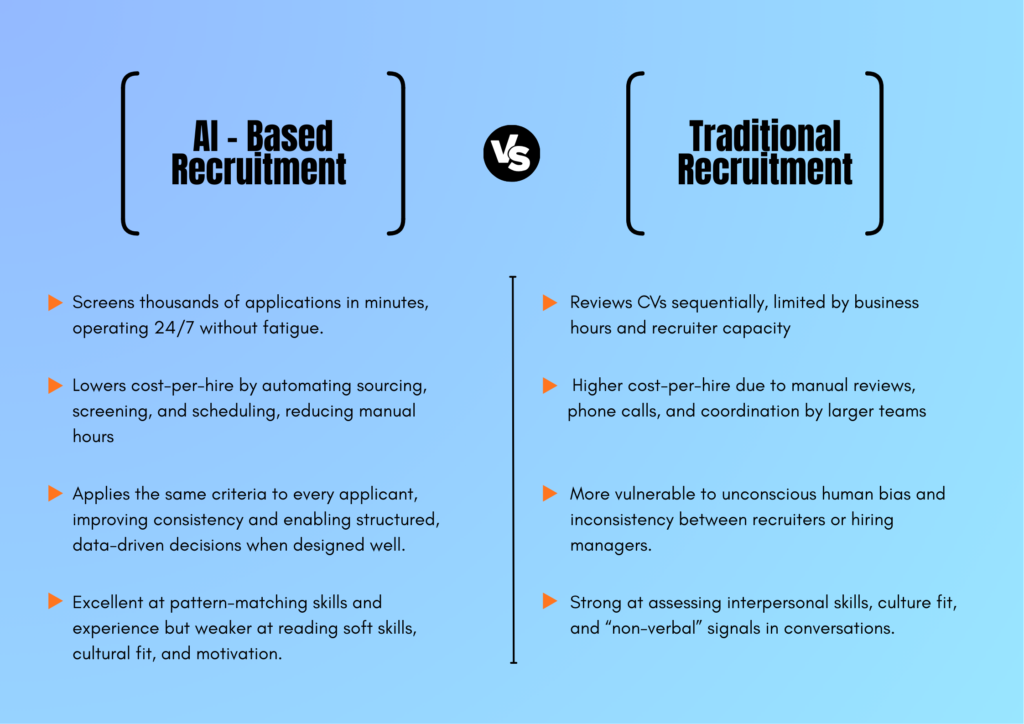
AI Recruitment vs Traditional Recruitment – A Quick Comparison
AI recruitment delivers speed, scalability, and data-driven consistency. Traditional recruitment excels in roles requiring human judgment, trust, and nuanced evaluation.
Why a Hybrid Recruitment Approach Works Best
Most modern organizations adopt a hybrid approach, using AI to handle volume and automation, while recruiters focus on interviews, decision-making, and candidate relationships. Deloitte and Harvard Business Review consistently identify this model as the most effective long-term strategy.
Choosing the Right Recruitment Strategy for Your Business
The right recruitment approach depends on hiring volume, role complexity, and business goals. Organizations that align technology with human expertise are best positioned to hire efficiently without compromising quality.
For HR teams looking to modernize recruitment while maintaining control and transparency, platforms like SmartHCM enable this balance, bringing automation, analytics, and human decision-making together in one unified system.
🚀 Ready to modernize your hiring process?
Book a SmartHCM demo and see how AI-powered recruitment can help you hire faster, reduce costs, and improve hiring quality, without sacrificing the human touch.
References
- LinkedIn Talent Solutions – How AI Is Changing Recruiting
- Gartner – Market Guide for AI Applications in Talent Acquisition
- Wikipedia – Artificial Intelligence in Hiring
- SHRM (Society for Human Resource Management) – Talent Acquisition & Recruitment Resources
- SHRM – Cost-per-Hire Benchmarking



